Welcome to my home.
“Ahlan wa sahlan fi bayti.”
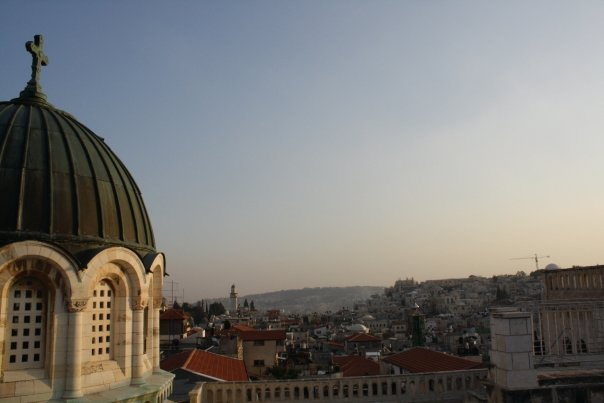
Mariam, a Palestinian Christian woman in her forties, motions my husband and I into her home. We met her at the hostel where we are staying, where she is employed. Her home, situated along the Via Dolorosa, sits in the Muslim Quarter of the Old City, near the Ecce Homo (Behold the man) arch at Pilate’s court. For centuries, pilgrims have queued here to observe the first station of the cross.
To get here, we passed a sign that reads “The prison of Christ,” and took the stairs up to a courtyard a few flights above the underground praetorium where, it is said, Jesus was scourged with leather straps knotted with pieces of wood and bone. and long thorns pressed onto his head.
We greet Mariam’s husband and mother-in-law, who stand up to shake our hands before settling back onto sofas. A TV screen flickers with the face of televangelist Benny Hinn. While sipping black tea from clear glass tumblers swirling with mint leaves, we do our best to chat across the divide– my rudimentary Arabic and their far better English.
I am distracted by the screen , as Hinn stands on a temporary stage erected just outside an Old City gate. The camera frames his face closely as he preaches to a crowd of tourists. This morning as we walked down the hill from our lodgings along Nablus Road, passing by the entrance to a site of the garden tomb, we had passed a row of Hinn’s tour buses, engines idling.
Born in Jaffa in 1952, Hinn’s Palestinian parents had him baptized as an infant by the Greek Orthodox Patriarch of Jerusalem. Hinn tells of becoming a born-again Christian in 1972 after his family moved to Canada, and brands himself as an Israeli-Canadian televangelist and faith healer, preaching a gospel message of health and prosperity, endorsed by Kenneth Copeland and Pat Robertson.
In the foreground, Mariam, a Palestinian Christian, pours me a second glass of tea, while on the screen behind her, Hinn breathes on a woman and she falls down onto the stage.
Hinn’s prosperity gospel message is heavily shaped by the 19th-century evangelical minds of Dispensationalist, John Nelson Darby and his protoge, C.I. Scofield. Hinn preaches a rapture theology that reinforces the Platonic notion of a disembodied soul splitting from the body for eternity, rather than the early Christian understanding of a full bodily resurrection and restoration of all things. Anglican Bishop, N.T. Wright, in Surprised by Hope, challenges this notion: “A massive assumption has been made in Western Christianity that the purpose of being a Christian is simply, or at least mainly, to ‘go to heaven when you die,’ and texts that don’t say that but that mention heaven are read as if they did say it, and texts that say the opposite, like Romans 8:18–25 and Revelation 21–22, are simply screened out as if they didn’t exist.”
Here is Wright in Simply Christian: “The great drama will end, not with ‘saved souls’ being snatched up into heaven, away from the wicked earth and the mortal bodies which have dragged them down into sin, but with the New Jerusalem coming down from heaven to earth, so that “the dwelling of God is with humans” (Revelation 21:3).
When God dwelt with humans as human, the first time, humans mocked and beat him. Here, as we drink our tea, we are grateful guests of a Palestinian Christian family who not only traces their lineage to the first Christians of Jerusalem, but who live a mere three flights up from the very room where historians believe Jesus was held and beaten upon his arrest. I am not at all interested in the dramatic scenes of the televangelist on the screen. What I am curious to know, is what our Palestinian Christian hosts make of a man who distances himself from his Palestinian lineage, while enthusiastically promoting a theology that has resulted in generations of violence against his fellow Palestinian Christians.
***
In his introduction to The Christian Imagination, Willie James Jennings describes a formative memory that left him with a question similar to the one nestled in the hearts of our Palestinian Christian hosts: “Why did they (these Christian tourists) not know us?”
It happened when he was twelve years old. Jennings was with his mother in their back garden when two white men surprised them by appearing in their backyard. The men introduced themselves. They were from the First Christian Reformed Church down the street.
The men asked his mother’s name, then the older of the two proceeded to talk for a long time about their church the and the programs and activities they were launching for the children of the neighborhood. The younger man bent down to talk to Willie, asking him questions in a way that struck Willie as odd for a boy his age. “He talked to me like I was a kindergartner, or someone with little intelligence.”
“The strangeness of this event lay not only in their appearance in our backyard, but also in the obliviousness of these men as to whom they were addressing: Mary Jennings, one of the pillars of New Hope Missionary Baptist Church. I thought it incredibly odd that they never once asked her if she went to church, if she was a Christian, or even if she believed in God. Mary and her twin sister Martha were about as close to their scriptural counterparts as you could get. Without fail they were in their customary seats in church every Sunday, and you could calibrate almost every activity of the church by and around them or us, their children. In addition, every Sunday they would visit every single person on the sick and shut-in list. The depth and complexities of Mary’s faith were unfathomable, as unfathomable as the blindness of these men to our Christian lives. My mother finally interrupted the speech of this would-be neighborhood missionary, with the words, ‘I am already a Christian. I believe in Jesus, and I attend New Hope Missionary Baptist Church, where Rev. J.V. Williams is the pastor.’”
“I don’t remember his exact reply to my mother’s declaration of identity, but he kept talking for quite a few more wasted minutes. Finally, they gave her some literature and left. I remember this event, because it underscored an inexplicable strangeness embedded in the Christianity I lived and observed (Jennings).”
“Experiences like these fueled a question that has grown in hermeneutic force for me: Why did they not know us? And not know the multitude of other Black Christians who filled the neighborhood that surrounded that church?
“The foreignness and formality of their speech in our backyard signaled a wider and deeper order of not knowing, of not sensing, of not imagining. The most common way to narrate this historical reality of western Christianity displayed in my backyard, is to speak of different Christianities–White and Black, or different cultural expressions of Christianity–European immigrant and African slave, or even of a sinful division by faith formed from the historical realities of slavery. However, such narratives draw away too quickly from the strangeness displayed at the edge of my mother’s garden.
“In the small space of a backyard, I witnessed a Christianity familiar to most of us, enclosed in racial and cultural difference, inconsequentially related to its geography, often imaginatively detached from its surroundings, of both people and spaces, but one yet bound to compelling gestures of belonging and invitation. Here, however, we were operating out of a history of relations that exposed a distorted relational imagination.”
***
Jesus said the Kingdom of Heaven is like yeast worked through the dough. Yeast is alive. Its effects are not immediate, but gradual. In Luke 17:21, we read Jesus’ words: “The Kingdom of Heaven is among you.” When we talk about the “already but not yet” of the Kingdom of Heaven, the tendency is to focus the conversation on the “not yet.” What about the already? What does the Kingdom of Heaven among us even look like?
From the Black Church in the United States to the Eastern churches of Africa and Asia who trace their Christian roots to the first few centuries of the faith, these our early church fathers and mothers are largely overlooked by Christians of European descent, (including the pilgrims who tour the Church of the Nativity in Bethlehem or Church of the Holy Sepulcher).
***
Why didn’t they know us?
Decades ago, my college gospel choir, Angels of Harmony, was invited to sing at a suburban megachurch outside Baltimore, MD. The choir was majority Black American and also included Latinx, White, and international students.
That Sunday morning’s service included a “missions moment,” in which a White family on furlough from a missionary assignment in Sub-Saharan Africa presented a slide show about the village where they had been living. One photo showed a group of men working to move a mound of earth with shovels and the presenting missionary’s comment, “Here we see an African backhoe,” drew chuckles from several people in the audience. Another slide showed the bathroom facilities, which were not hooked up to plumbing. The focus of the presentation seemed to be on the primitive living conditions of the people they had come to call their neighbors. A phrase repeated during the presentation was “bringing Christianity to Africa.”
When it was Q&A time, a fellow choir member stood to his feet. “I am a proud African man. I am Luo, a Kenyan, and a Christian. As an African I am offended by your presentation. You insult the dignity of my African brothers and sisters. You speak of bringing Christianity to Africa. As an African Christian, this offends me. Have you not heard of King Azana of the Kingdom of Aksum? Have you not heard of the Kingdom of Abyssinia? Of the Ancient Coptic Church?”
I don’t remember what the missionary said in response. As a White western Christian, I was totally embarrassed by the over-indulged childish ignorance of my cultural group.
As a student and professor in several western Reformed academic settings, Dr. Jennings writes about “the resistance of theologians to think theologically about their identities.”
“It was the negation of a Christian intellectual posture reflective of the central trajectory of the incarnate life of the Son of God, who took on the life of the creature— a life of joining, belonging, connection, and intimacy. Indeed, it is as though Christianity, wherever it went in the modern colonies, inverted its sense of hospitality. It claimed to be the host, the owner of the spaces it entered, and demanded native peoples enter its cultural logics, its ways of being in the world, and its conceptualities. Western Christian intellectuals still imagine the world from the commanding heights (Jennings, The Christian Imagination).”
These comments bring to mind the phenomenon of recent, crowd-drawing praise and worship spectacles held in urban settings, led by Christians who are not from those communities. These “Let Us Worship” events are billed as “taking back” a certain neighborhood or city, “for God,” and paints that place (of which the organizers know very little) as a battleground for competing spiritual forces.
A particularly problematic instance occurred in the late summer of 2020, as former GOP Congressional candidate in California’s 3rd District, Sean Feucht, came to the heart of Minneapolis where Mr. George Floyd had been murdered by White police officer, Derek Chauvin, and set up a sound stage. Using the format of a mass gathering (the COVID pandemic was still rampant), Feucht promoted these events on his large social media platform as “Riot to Revival.”
Of Feucht’s performative actions, Portland pastor, Jelani Greenidge, wrote on his personal blog: “Riding in from out of town to “bring Jesus to Portland” (a sentiment I’ve heard used repeatedly in reference to these and similar gatherings) is disrespectful to the local Christian ministers of all denominational stripes who’ve been doing their best to live out the words and mission of Jesus for decades. Given the context, their efforts were tone-deaf, unresponsive to the needs and mood of the people who’ve been engaging with the hurt and chaos on the ground (Don’t Understand the Sean Feucht Controversy? Stop Talking & Listen.)”
Situations like the one I describe, in which cries for justice are ignored and the cry of our neighbor is drowned out, bring to mind God’s rebuke to the people of Israel: “Take away from Me the noise of your songs! I will not listen to the music of your harps. But let justice roll on like a river, and righteousness like an ever-flowing stream” (Amos 5).
If we are honest, we must acknowledge that history is full of examples where actions carried out under the banner of religion have served only human ego and inflicted spiritual harm. Yet, “There is within Christianity a breathtakingly powerful way to imagine and enact the social, to imagine and enact connection and belonging (Jennings, The Christian Imagination).”
How we conceptualize the “not yet,” of the Kingdom of Heaven, will inevitably shape how we live out the “already.” In his lecture, Imagining the Kingdom, Anglican bishop, N.T. Wright argues: “The assumption today that ‘the kingdom of God’ denotes another realm altogether, for instance that of the ‘heaven’ to which God’s people might hope to go after their death, was not on the first-century agenda. When Jesus spoke about God’s kingdom, and taught his followers to pray that it would arrive ‘on earth as in heaven’, he was right in the middle of first-century Jewish theocratic aspirations.”
“Salvation, then, is not ‘going to heaven’ but ‘being raised to life in God’s new heaven and new earth.’ But as soon as we put it like this we realize that the New Testament is full of hints, indications, and downright assertions that this salvation isn’t just something we have to wait for in the long-distant future. We can enjoy it here and now (always partially, of course, since we all still have to die), genuinely anticipating in the present what is to come in the future. ‘We were saved,’ says Paul in Romans 8:24, ‘in hope.’ (Wright, Surprised by Hope: Rethinking Heaven, the Resurrection, and the Mission of the Church).
Indeed, the yeast of the Kingdom is at work, often where we lack the imagination to recognize it. Its appearance might disappoint the “theocratic aspirations” we are accustomed to imagining, replete with extrabiblical images of the Eschaton that may have shaped our thinking. Like yeast, the Kingdom of Heaven is alive, and we are to seek it, especially in places where, without a Kingdom imagination, Jesus himself cannot be recognized.
 Step closer.